
Case Study · 7 min read · Updated July 21, 2026
Case Study: Real-Time AI Translation at Nikkei Asia Forum APAC 2026
How TranSphere delivered live English → Japanese, Chinese, and Thai AI interpretation for Nikkei Asia Forum APAC 2026 at Park Hyatt Bangkok on 16 July 2026: QR-code badge access for around 400 in-room attendees, live translation embedded inside Nikkei’s official livestream page for around 2,000 online viewers, real-time transcripts, and auto-generated AI summaries for all 10 sessions.
EN → JA · ZH · TH
Languages live
~400
In-room attendees
~2,000
Online viewers
10
Sessions in one day
TranSphere provided the live AI interpretation layer for Nikkei Asia Forum APAC 2026, a high-level hybrid business forum hosted by Nikkei at Park Hyatt Bangkok on 16 July 2026. Across a full-day program of 10 sessions, English stage content was translated live into Japanese, Chinese, and Thai for around 400 in-room attendees and around 2,000 online viewers — with real-time transcripts, live translation embedded directly inside Nikkei's official livestream page, and an AI-generated summary published at the end of every session.
This page documents how the deployment worked end to end: the client's requirements, how attendees accessed translation in the room and online, how the livestream integration was built, and what the outcome was.
The event
Nikkei is one of Japan's most established media organizations, and its Asia Forum series convenes senior business and policy leaders from across the Asia-Pacific region. The 2026 APAC edition, themed "Building a Robust Region for Sustainable Business Growth", ran as a full-day hybrid event at Park Hyatt Bangkok on 16 July 2026: ten sessions of keynotes, fireside chats, and panels in the room, plus a video livestream hosted on Nikkei's own official event page for the online audience.
The speaker lineup was the kind that leaves no room for translation errors: Thailand's Deputy Prime Minister and Minister of Finance, the Deputy Prime Minister and Minister of Foreign Affairs, the Ambassador of Japan to Thailand, and top executives from Sony Group, Toyota Motor, SCG, the Stock Exchange of Thailand, and SGX Group.
The stage language was English. The audience was not: a large share of attendees — in the room and online — followed the program in Japanese, Chinese, or Thai.
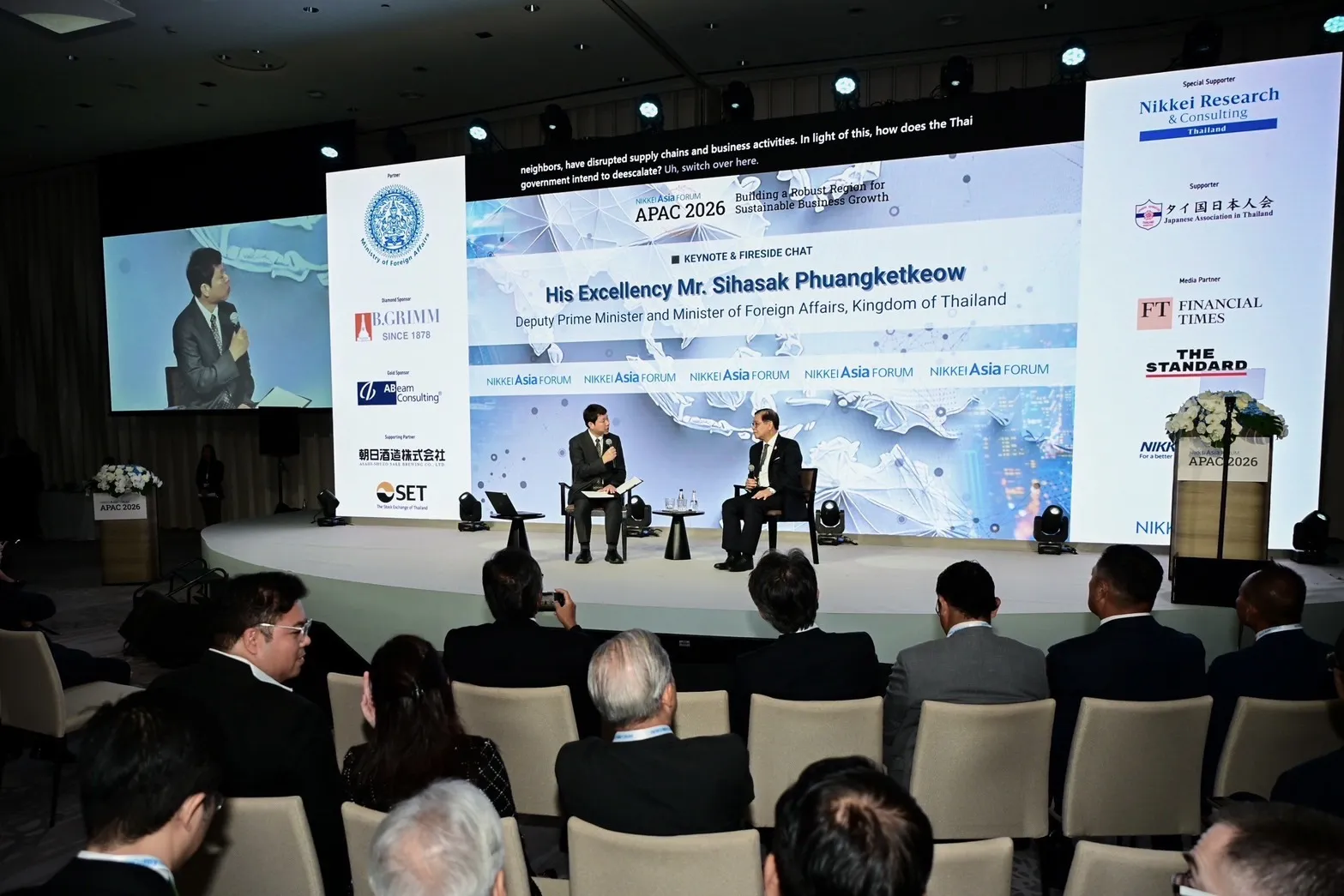
A fireside chat at Nikkei Asia Forum APAC 2026 — TranSphere's live captions running above the stage backdrop as the session unfolds.
The client's challenge
Nikkei's requirements went beyond "put captions on a screen":
- A multilingual audience, one stage language. The program needed to be equally followable in Japanese, Chinese, and Thai, live, without interpreter booths or headset logistics.
- Translation inside their own livestream page. Nikkei runs its own event page with its own video streaming. They did not want online viewers redirected to a third-party viewer — live translation had to appear inside the official livestream page, with each viewer choosing their own language there.
- A very high quality bar. Nikkei is a traditional company with exacting editorial standards. Before the event, the team was openly skeptical that AI translation could meet the quality expected at a Nikkei forum.
Languages provided
TranSphere ran the event as one English source feed fanned out into three parallel translation streams:
- English → Japanese
- English → Chinese
- English → Thai
All four languages (source transcript plus three translations) ran simultaneously from a single stage audio feed. Every attendee picked their own language and could switch at any time without losing their place in the session. For background on how the models handle these specific languages, see our guide to AI translation for Thai, Chinese, Japanese, and Korean.
How in-room attendees accessed translation
Nikkei printed a TranSphere QR code on the back of every attendee badge. Access for the roughly 400 people in the room worked like this:
- Flip the badge, scan the QR code with a phone camera.
- The browser opens the live session viewer — no app install, no account.
- Pick a language: English transcript, Japanese, Chinese, or Thai.
- Read the live transcript and translation in real time as the speaker talks.
No receivers were handed out, no headsets collected, no hardware inventory managed. The badge every attendee already carried was the access channel.
Embedding live translation into Nikkei's official livestream page
The online audience — around 2,000 viewers — watched the forum on Nikkei's own event page, on Nikkei's own video stream. TranSphere provided an embed code that Nikkei's web team dropped into that page, adding a live translation panel with a language selector directly alongside the video player.
The result: online viewers watched the official stream and read live translation in their chosen language on the same page, in Nikkei's own branding, without ever leaving the official event site. TranSphere's browser-based delivery meant the embed needed no plugin or player integration — it is a lightweight component that streams translation text in real time.
Live transcripts
Every session produced a live English transcript alongside the three translation streams. Text streamed phrase by phrase as the speaker talked, with captions finalizing within seconds — fast enough for in-room attendees to follow a panel discussion on their phones and for online viewers to read along with the video stream.
Session summaries
The moment each of the ten sessions ended, TranSphere automatically generated an AI session summary — the key points and takeaways of that keynote or panel, available immediately in the viewer. Attendees who stepped out, joined late, or split their attention across a busy forum day could catch up on any session in a minute rather than scrubbing through a recording.
Scale and reliability
The deployment served roughly 2,400 attendees across four simultaneous language streams for the full 10-session day:
- Around 400 in-room attendees on the QR badge flow
- Around 2,000 online viewers on the embedded livestream integration
- Four parallel streams (English transcript + Japanese + Chinese + Thai) per session
Delivery is fully browser-based, so scaling to the online audience required no additional hardware on either side. Ahead of the event, the platform was load-validated at 2,000 concurrent viewers across four simultaneous language streams, and the event itself ran with on-site technical support monitoring every session.
The outcome
Nikkei's team came into the project skeptical — a reasonable position for a traditional Japanese media company with very high standards evaluating AI interpretation for the first time. The post-event feedback, from both Nikkei and forum attendees, was very positive: the AI translation was much better than they expected — fast and accurate — and the overall AI interpretation service met the quality bar of a Nikkei event.
What convinced them was the combination:
- Live translation quality close to experienced human interpreters for clear stage content
- Zero-friction access — a badge-back QR code for the room, a language selector inside their own livestream page for everyone else
- Transcripts and instant session summaries that kept delivering value after each session ended
Case video of Nikkei Asia Forum APAC 2026 event.
What this deployment shows
- Hybrid audiences can dwarf the room. Five times more people followed this forum online than in person — the translation experience for embedded livestream viewers mattered as much as the in-room one.
- Translation belongs inside the official event page. An embed code that adds a language selector to the client's own livestream keeps the audience on the client's property, in the client's branding.
- QR-on-badge is the cleanest in-room access pattern. Printing the code on the badge every attendee already wears removes signage dependence and entrance bottlenecks.
- Summaries extend the value of every session. Auto-generated recaps turn a live translation service into a lasting content asset for the event.
- AI interpretation now passes a skeptical, high-standards evaluation. A client that did not believe AI translation could be good enough ended the event very satisfied with it.
Frequently asked questions
Can TranSphere embed live translation into our own livestream or event page? Yes. TranSphere provides an embed code that adds a live translation panel with a language selector to your existing event page, alongside your own video player — exactly as deployed for Nikkei Asia Forum APAC 2026.
How do in-room attendees join? Through a QR code — on screen, on signage, or printed on the badge itself, as Nikkei did. Scanning opens the live viewer in the phone browser; there is no app to install and no hardware to distribute.
How many languages can run at the same time? This event ran four (English transcript plus Japanese, Chinese, and Thai translations). The platform supports more parallel streams per event — see how to choose an AI translation provider for what to ask about language scaling.
Are transcripts and summaries available after the event? Yes. Session transcripts are persisted and an AI summary is generated automatically at the end of every session, so the content remains useful after the live program ends.
Planning a multilingual conference or hybrid forum? Request a quote and we will recommend the right setup, or read what AI event translation is if you are evaluating the approach for the first time.