
Case Study · 4 min read · Updated November 17, 2026
Case Study: Thai and English AI Voice Interpretation at TIMPs 2026
How TranSphere delivered AI voice interpretation in Thai and English at the Thai Interventional and Multidisciplinary Pain Management Symposium (TIMPs) 2026 at Grand Hyatt Erawan Bangkok on 29–30 August 2026: two rooms, 34 scheduled sessions, QR access on attendees’ own phones and no interpreter booths.
TH ⇄ EN
AI voice and text
34
Scheduled sessions
2
Rooms
2
Days
TranSphere provided live AI interpretation for the Thai Interventional and Multidisciplinary Pain Management Symposium (TIMPs) 2026, held on 29–30 August 2026 at Grand Hyatt Erawan Bangkok. Across two days, two rooms and 34 scheduled sessions, every lecture was available as AI voice in Thai or English, played on attendees' own phones after a QR scan. There were no interpreter booths on site.
This page describes how a medical symposium ran voice interpretation from attendees' phones.
The event
TIMPs 2026, themed "Back to the Back: Advancing Effective Spine Pain Management", was organized by the Chula Pain Management Unit. The program was clinical: plenary lectures, honorary lectures and specialist sessions on interventional pain procedures, in the Grand Ballroom and a second room.
Sessions were interpreted in both directions, English to Thai and Thai to English, for an audience that needed to keep its eyes on the slides and procedure images while it listened.
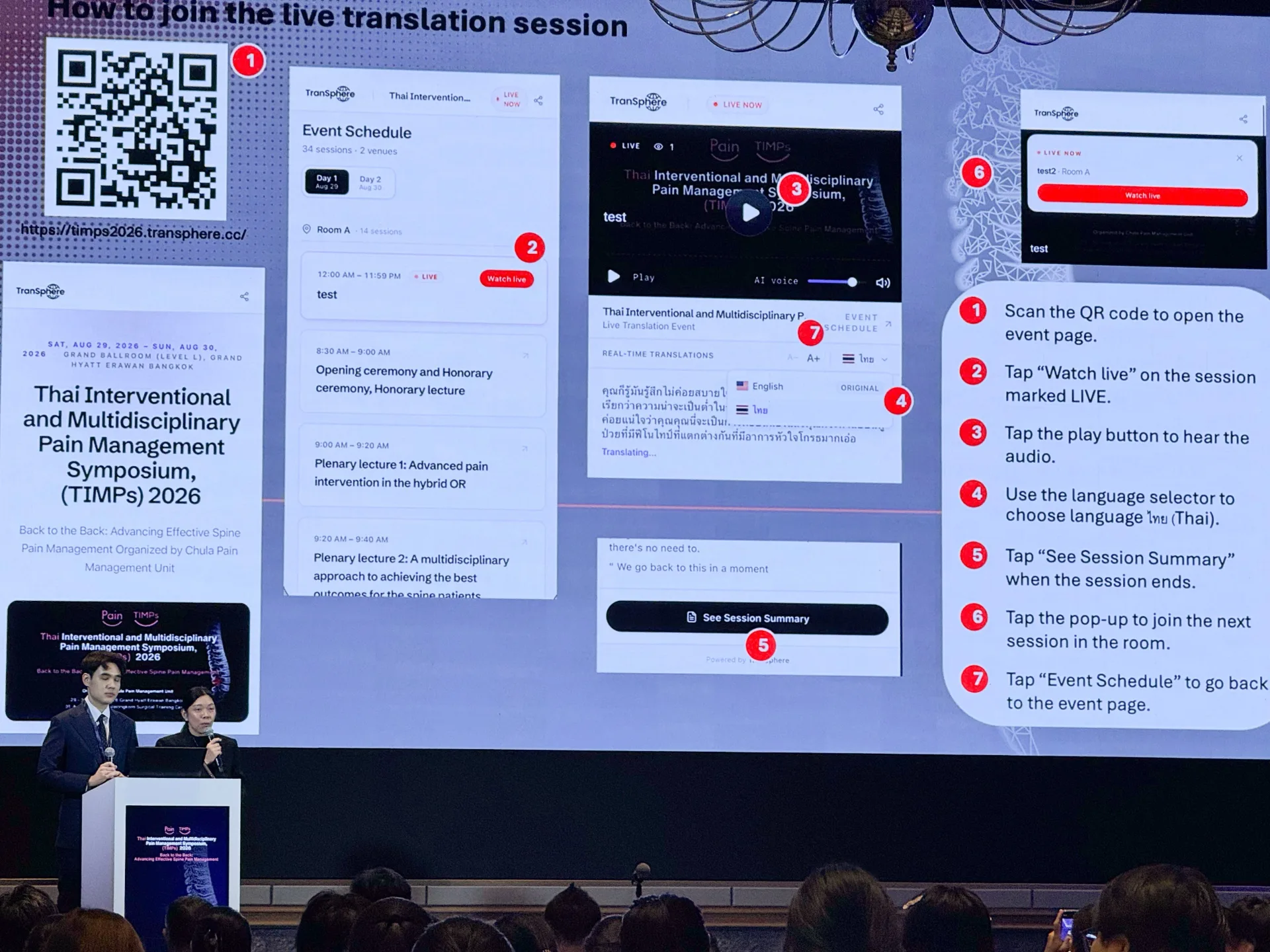
The hosts walk the audience through joining: scan the code, tap "Watch live", press play and choose a language.
Languages provided
- Thai
- English
Each session offered both, as text and as AI voice. Attendees chose the one they wanted and could switch during a lecture.
How attendees joined
The hosts showed a how-to-join slide from the stage, and the event had its own address, timps2026.transphere.cc. The steps on the slide were the whole process:
- Scan the QR code to open the event page.
- Tap "Watch live" on the session marked live.
- Press play to hear the audio.
- Choose a language with the language selector.
- Tap "See Session Summary" when the session ends.
- Tap the pop-up to join the next session in the room.
- Tap "Event Schedule" to go back to the event page.
Attendees used their own earphones. Nothing was handed out at registration and nothing had to be returned.
Look up, listen in
Voice was the main channel here, not a supplement to captions. A lecture on spinal intervention is taught from images, and an attendee reading captions on a phone is not looking at them. With AI voice in one ear, attendees watched the screen and heard the lecture in their own language.
Text stayed available in the viewer for anyone who wanted to check a term.
Two rooms, 34 sessions
The event page listed the full schedule for both days and both rooms. When one session ended, the viewer offered its AI summary and prompted the attendee to join the next session in the same room, so nobody had to scan again between lectures.
What this deployment shows
- Voice suits medical content. Attendees who must watch slides and images are better served by listening than by reading.
- A slide is enough onboarding. Seven short steps on the main screen, shown once, got a room of clinicians connected.
- The schedule is part of the product. With 34 sessions over two days, moving attendees from one session to the next automatically mattered as much as the translation itself.
Frequently asked questions
Can attendees listen instead of reading captions? Yes. AI voice interpretation plays in the phone's browser through the attendee's own earphones, in the language they choose.
Is AI translation suitable for medical conferences? It is used at medical symposiums like this one, and specialist vocabulary can be loaded in advance. For high-stakes legal or clinical decisions, a human interpreter remains advisable. See AI vs human interpreters.
Can an event have its own web address? Yes. This symposium used its own subdomain, and an event can also run on the organizer's own domain.
Planning a medical congress? Request a quote with your rooms, days and languages.