
Case Study · 3 min read · Updated November 17, 2026
Case Study: Eight Languages in Four Rooms at the World Conference on Creative Economy 2026
How TranSphere delivered live AI translation at the World Conference on Creative Economy 2026 in Jakarta: four rooms running at once, more than 2,000 attendees, English and Bahasa Indonesia subtitles on the venue screens and eight languages on attendees’ phones by QR code.
8
Languages per room
4
Rooms at once
2,000+
Attendees
TranSphere provided live AI translation for the World Conference on Creative Economy 2026 in Jakarta, Indonesia. The conference ran in four rooms at the same time, for an audience of more than 2,000 attendees, in eight languages. English and Bahasa Indonesia subtitles ran on the venue screens, and every attendee could read any of the eight languages on their own phone after scanning a QR code.
This page describes how a multi-room, eight-language conference was set up and what attendees saw.
The event
The World Conference on Creative Economy brings together governments, creative industries and international organizations. The 2026 edition, its fifth, was held in Jakarta with parallel tracks: plenaries, panels and working sessions running side by side in four rooms.
The delegates came from many countries. An interpreter booth per room and per language was not a practical way to serve them across four parallel tracks.
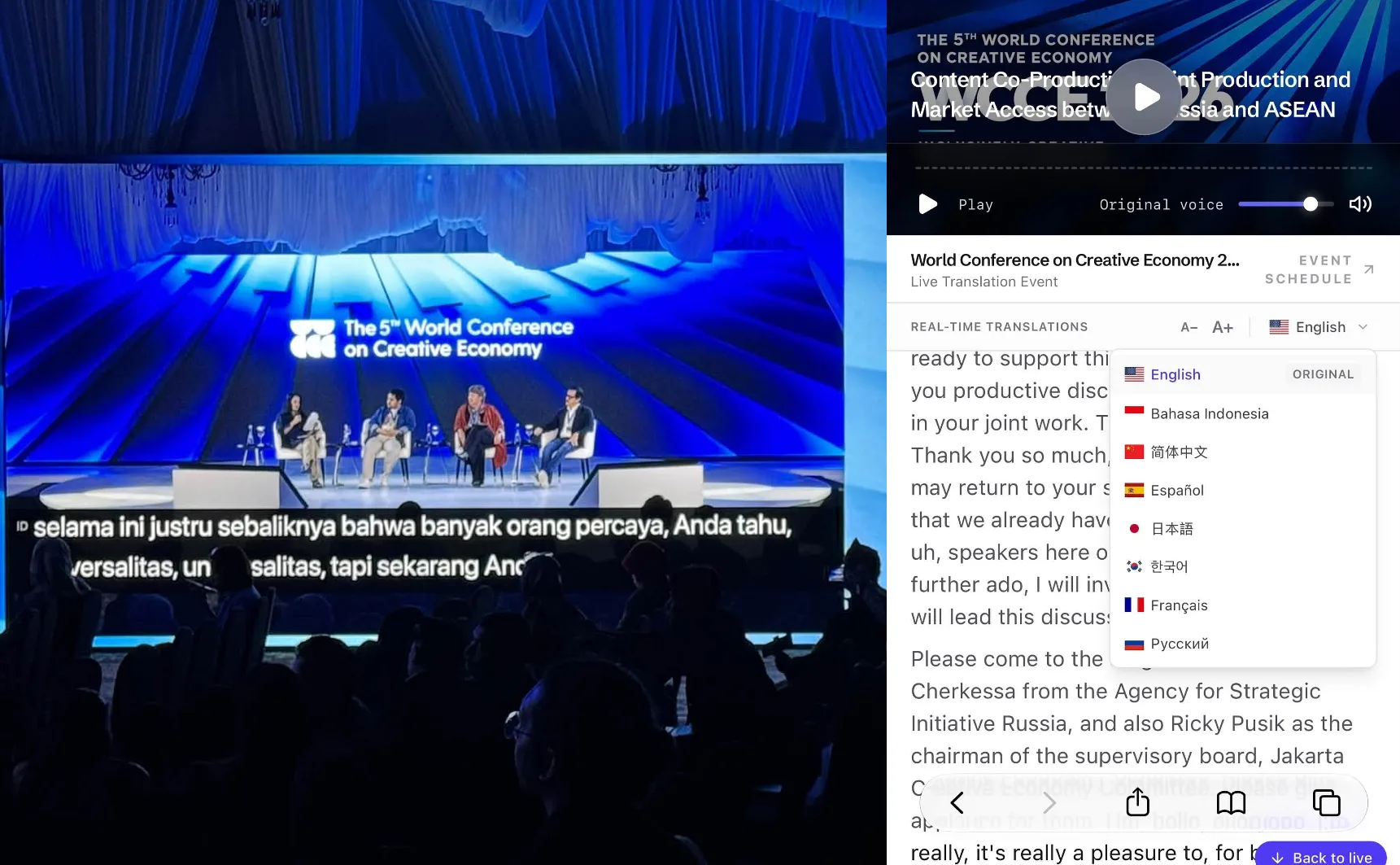
Left: Bahasa Indonesia subtitles on the main screen during a panel. Right: the attendee viewer on a phone, with the language menu open.
Languages provided
Each room ran one transcript and seven translations in parallel. The language menu attendees saw on their phones listed:
- English
- Bahasa Indonesia
- Simplified Chinese
- Spanish
- Japanese
- Korean
- French
- Russian
Attendees picked a language once and could switch at any time. For how the models handle Asian languages in particular, see our guide to AI translation for Thai, Chinese, Japanese and Korean.
Four rooms at once
Each room had its own TranSphere operator desk, its own audio feed from the room's mixer and its own session on the event page. The four rooms ran independently, so a late start or an overrun in one room did not affect the others.
Attendees opened one event page from the QR code. The page listed every room's schedule and marked the sessions that were live, so someone moving between tracks joined the next room's translation with a tap.
On the screen and on the phone
The two delivery channels did different jobs:
- Venue screens showed English and Bahasa Indonesia subtitles, the two languages most of the room could read.
- Phones carried all eight languages, so a delegate who needed Spanish or Korean was served without adding anything to the stage.
Attendees installed no app and received no hardware. Scanning the code opened the viewer in the phone's browser.
What this deployment shows
- Rooms scale independently. Four concurrent rooms were four separate sessions under one event page, each with its own operator.
- The screen cannot carry every language, and it doesn't have to. Two languages on the screen and eight on phones covered an international audience without crowding the stage.
- Language count is no longer set by booth count. Eight languages in four rooms would have meant dozens of interpreters; here it was a configuration choice.
Frequently asked questions
Can TranSphere run several rooms at the same time? Yes. Each room is its own session with its own audio feed and operator, listed together on one event page. This conference ran four rooms concurrently.
How many languages can one session carry? This event ran eight per room: the transcript plus seven translations. See how to choose an AI translation provider for what to ask about language scaling.
Do attendees need an app? No. A QR code opens the viewer in the phone's browser, and the attendee picks a language there.
Planning a multi-track conference? Request a quote with your room count and languages, or read what goes into a conference translation quote.